By now, it's clear to me as to why most Youtube channels fail. Most things have simple explanations until you start looking for answers for your own use cases.
If you have ever spent six hours researching a topic, scripting a video, recording three separate takes, editing the timeline down to the frame, and designing a thumbnail only for YouTube to award you with 47 total views, I know exactly how you feel.
I’ve been there. As the creator behind fetchprofits Youtube channel, my core business is built around understanding digital infrastructure: Meta Ads, high-converting funnels, email marketing, and server-side tracking. When it comes to conversion pipelines, I know how the plumbing works.
But when I first started taking YouTube seriously, I ran into a frustrating reality: YouTube isn't just a video platform. Far from just that.
It’s a search engine and a recommendation engine wrapped into one. The reason why most Youtube channels fail (and I struggle) is because I just skipped on the how your content is discovered (compared to every other social platform)
You can deliver the single best marketing insight on the internet, but if your title doesn't trigger search intent, if your thumbnail doesn't win the click-through rate (CTR), and if your tags don't signal relevance to the algorithm, your video stays buried.
For months, I fell into the trap that kills most small channels: publishing blindly. Just because I've read that consistency is the key.
I guessed what my audience wanted, picked titles that sounded clever to me, and hoped the YouTube algorithm would magically find my target audience.
It didn't.
Things only changed when I stopped guessing and started treating YouTube optimization like an engineering problem. That’s when I integrated VidIQ into my creator workflow—and why it’s now an essential tool in my stack.
The Core Mistake Small Creators Make ( "Clever" vs. "Searched")
First things first, unless your name is Mr.Beast, search should still be the main way people discover content on Youtube. That's how nyou take advantage of the in-built distribution system that Youtube is so good for.
When you run a business or an agency, you think in terms of depth. You want to teach advanced concepts like server-side GTM setup, Meta CAPI deduplication, or multi-step email nurture flows.
However, when a user opens YouTube or Google, they aren't searching for abstract concepts. They are searching for immediate solutions to specific problems:
In my case, it goes something like this:
- "Conversions API for Meta ads"
- "How to fix Meta Ads conversion tracking"
- "Shopify alternative for digital products"
- "Facebook ad setup step by step"
When I started out, I was naming videos with clever, vague titles. I was treating my video titles like blog headlines from 2012.
The turning point came when I realized that YouTube's algorithm doesn't care how "clever" a title is. It looks for data signals:
- Search Volume: Are real human beings actively typing these keywords into the search bar?
- Competition Score: Are 10,000 massive channels already occupying the top search results for this keyword?
- Viewer Intent: Does the title and thumbnail promise a direct answer to the user's immediate question?
If you target high-volume keywords with ultra-high competition, a small or growing channel will get crushed every time. If you target zero-volume keywords, nobody ever finds you. You have to find the sweet spot: High Search Volume, Low Competition.
Finding that intersection manually takes hours of research. Doing it with data takes seconds.
How I Use VidIQ to Engineer YouTube Content
VidIQ essentially acts as a co-pilot attached directly to your YouTube Studio and browser. Instead of creating a video and praying it gets traction, you reverse-engineer the demand before you ever hit record.
Here is the exact framework I use to plan, optimize, and rank content.
Step 1: Uncovering Low-Hanging Keyword Opportunities
Before I write a single line of script, I open the VidIQ Keyword Tool.
I type in a seed keyword related to my niche—for example, "Meta Ads setup". VidIQ immediately returns a breakdown showing:
- Search Volume: Exactly how many monthly searches that topic gets.
- Competition Score: How hard it is to rank on page 1.
- Overall Score: An easy color-coded indicator (Green = Goldmine, Red = Avoid).
If a broad search term like "Meta Ads" is too competitive, VidIQ displays Related Keywords. In seconds, I might discover that "Meta Ads conversion tracking fix 2026" has high search volume but extremely low competition.
That right there is my video. I instantly know there is a hungry audience waiting for an answer, and very few creators are providing a clear solution.
Step 2: The Daily Ideas Engine (Beating Creator Burnout)
One of the hardest parts of running a YouTube channel alongside an agency or business is running out of content ideas. You sit down on a Friday afternoon, look at a blank screen, and ask, "What should I film today?"
VidIQ’s Daily Ideas tool uses AI trained on your specific channel's performance history and niche trends to deliver personalized video concepts every single day.
It doesn't just give you generic prompts; it assigns a predictive score (Very High, High, Medium) to each idea based on real-time search velocity. When I see an idea rated "Very High," I know the market is actively searching for that topic right now.
Step 3: Optimizing Titles and Thumbnails for High CTR
You can win search rankings, but if your Click-Through Rate (CTR) is abysmal, YouTube will stop recommending your video within 48 hours.
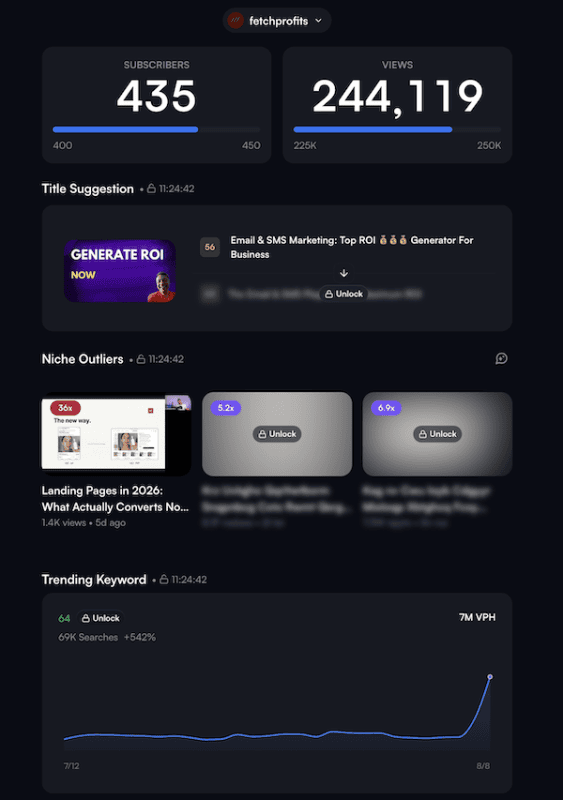
VidIQ includes an AI Title Recommendations generator and a Thumbnail Preview tool.
- Title Optimization: Instead of guessing, I feed my base title into the tool. It suggests 5–10 variations optimized for curiosity, benefit-driven hooks, and keyword placement.
- Competitor Thumbnail Audit: The overlay tool lets me see my proposed thumbnail side-by-side with the top-ranking videos for that keyword. If every top video uses a blue background, I make mine bright yellow or neon red so it stands out on the feed.
Step 4: Video SEO & Tag Scorecards
When you upload a video, VidIQ gives you a real-time SEO Scorecard out of 100.
It checks your:
- Title keyword density
- Description length and first-two-line preview
- Tag diversity and actionable tags
- Competitor tag matches
It removes the guesswork from publishing. When that SEO meter turns green, you hit publish knowing your technical metadata is dialed in completely.
The Results: Turning From "Why Most Youtube Channels Fail" to Bringing In Revenue
Growing a YouTube channel isn't just about chasing vanity metrics or subscriber counts. For me, every video serves a dual purpose: delivering genuine value to the community and building trust for my business.
When you use data-backed tools to get your videos ranked:
- Search Traffic Becomes Evergreen: A well-optimized video continues to pull in qualified views, leads, and sales for months—even years—after you upload it.
- Authority Increases: When people search for a problem and your video consistently appears in the top 3 results, you become the default authority in your space.
- The Feedback Loop Accelerates: Higher views lead to better data, which helps you refine your future content strategy even further.
Is VidIQ Worth It for Growing Channels?
If you view YouTube as a casual weekend hobby, you don't need dedicated optimization software.
But if you are serious about building an audience, growing a brand, or using video to generate leads and revenue, trying to grow on YouTube without keyword data is like running paid ad campaigns without installing a conversion pixel—you are burning effort in the dark.
VidIQ gives you the clarity to know what to make, how to title it, and why it will perform before you hit record. It's free to use so you have nothing to lose.
Stop leaving your channel’s growth to luck.
👉 Try VidIQ for Free & Upgrade Your YouTube Strategy Here