Ever searched for Claude Skills for Analytics and reporting? The new AI Skills Marketplace by Databox is a game-changer, it adds more skills to Claude or n8n, and totally transforms how you manage analytics, cross-channel reporting, and so much more.
Get this: Every Monday morning, a collective sigh echoes across marketing departments and digital agencies worldwide. It’s the sound of highly paid account managers, data analysts, and marketing specialists logging into Google Analytics 4, Meta Ads Manager or the Meta Business Suite, Google Ads, and LinkedIn Campaign Manager.
For the next three to four hours, their job titles morph from "Strategic Growth Marketers" to "Data Transcribers."
They copy numbers from one tab, paste them into a spreadsheet, take screenshots of graphs, and try to cobble together a cohesive narrative for clients or internal executives.
The worst part? They did this exact same dance last Monday. And the Monday before that.
It is the most common weekly pain in modern marketing: pulling an expert-grade, cross-channel report without rebuilding the entire data infrastructure each time.
Marketing analytics software historically promised to solve this with templates. But dashboards are notoriously fragile; a single API change or a custom event naming convention can break a widget, leaving you back at square one.
Moreover, a traditional dashboard only displays data—it doesn't interpret it. It still requires a human analyst to log in, spot the trends, and write down the action items.
That era is officially over. Databox has introduced a fundamental paradigm shift in how marketing teams interact with data: The AI Skills Marketplace.
Instead of building, maintaining, and manually interpreting fragile dashboards, marketing teams can now deploy pre-engineered "Skills" and automated "Workflows" that analyze data, uncover insights, and deliver professional-grade reports directly to where teams actually work: Slack and email.
Or you can use automations to find other places where your reports to surface.
The Two Pillars of the AI Skills Marketplace: AI Skills vs. Automated Workflows
To understand why this changes everything, it helps to understand how the Databox AI Skills Marketplace is structured. It isn't a gallery of static widgets. It is an ecosystem built on two operational pillars: AI Skills and Automated Workflows.
- AI Skills (Triggered On-Demand via Claude): Think of an AI Skill as a specialized data analyst living inside your system. When triggered, the skill pulls live data from your connected accounts and passes it to an advanced language model (like Anthropic’s Claude). The AI doesn't just look at the numbers; it contextualizes them against historical baselines, identifies anomalies, and drafts an executive summary with clear action items.
- Automated Workflows (Powered via n8n): Workflows are the delivery infrastructure. Powered by the powerful automation engine n8n, these workflows handle the scheduling, formatting, and cross-platform routing. They ensure that the insights generated by your AI Skills don’t sit in a dark corner of an analytics portal, but instead stream automatically into your team’s Slack channels or client email inboxes exactly when needed.
For marketing agencies managing dozens of clients, this combination means you can systematically scale "expert-grade" reporting without adding headcount. Let's look at how this applies to the two biggest reporting headaches agencies face: GA4 and Paid Ads.
Deep Dive 1: Automating the GA4 Website Traffic & Performance Loop
Google Analytics 4 is undeniably powerful, but its native user interface remains a persistent point of friction for clients and internal teams alike. Finding simple answers—such as which traffic channels driven by recent campaigns are converting at the highest rate—often requires navigating multiple sub-menus and building custom explorations.
The GA4 Website Traffic & Performance Report skill eliminates this friction entirely.
How the Skill Operates
When deployed, the workflow automatically connects to your specified GA4 property. Rather than presenting a static chart of sessions and page views, the backend logic groups data into critical behavioral pillars:
- Acquisition Efficiency: Where traffic is originating and whether the mix of organic, paid, and referral sources is healthy.
- Engagement Quality: How users are interacting with the site, tracking shifts in average engagement time and key event triggers.
- Conversion Economics: Mapping specific traffic channels directly to conversion events or e-commerce purchases.
The AI Interpretation Layer
Once the data is compiled, the AI Skill passes the dataset to Claude. Instead of a generic summary, the AI generates a clinical narrative:
"Overall sessions increased by 14% week-over-week, primarily driven by a 32% spike in Organic Social traffic. However, the engagement rate for Organic Social traffic dropped to 24% (compared to our site baseline of 48%), indicating that while the top-of-funnel hook worked, the landing page content did not align with visitor expectations. Conversely, Paid Search traffic volume fell by 5%, but total conversion volume from this channel rose by 12%, signaling highly qualified intent."
The End-Result Workflow
Using the integrated n8n delivery layer, this data does not wait for a manual export. You can configure a Daily Website Intelligence Report or a Traffic Spike Reporter.
If your site experiences an unusual surge in traffic from a specific referral source, the workflow identifies it instantly, prompts Claude to analyze the cause, and drops a alert directly into your team's Slack channel.
Deep Dive 2: Solving the Paid Ads Cross-Channel Nightmare with AI Skills Marketplace
If GA4 reporting is tedious, cross-channel paid advertising reporting is an absolute operational bottleneck. Agencies running holistic marketing strategies rarely rely on a single ad platform.
A typical mid-market client campaign often spreads budget across Meta Ads (for top-of-funnel awareness), Google Ads (for high-intent search capture), and LinkedIn Ads (for precise B2B account targeting).
Evaluating performance across these platforms normally requires logging into three separate ad managers, adjusting date ranges, accounting for different attribution windows, and normalizing terminology (e.g., Meta’s "Link Clicks" vs. Google’s "Clicks").
The Paid Ads Cross-Channel Performance Report skill acts as an automated data aggregator and translator.
Unifying the Ad Stack
This skill pulls data simultaneously from Meta, Google, and LinkedIn Ads. It unifies disparate metrics into a singular, cohesive executive health brief, highlighting:
- Total Blended Ad Spend: Exactly how much budget was deployed across all ecosystems over the specified timeframe.
- Cross-Platform Conversion Efficiency: Evaluating which network yielded the lowest blended Cost Per Lead (CPL) or Cost Per Acquisition (CPA).
- Macro Attribution Health: Identifying whether a drop in performance on one channel (e.g., an ad creative fatigue issue on Meta) is being offset by seasonal search intent gains on Google Ads.
From Raw Data to Media Buyer Insights
Because this workflow runs with an embedded AI layer, it doesn't just list data; it functions like an automated media director. If LinkedIn Ads are generating high-quality leads but at a CPA that exceeds the target threshold by 20%, while Google Search Ads are sitting on unused impression share with a highly profitable return, the AI flags this immediately.
It provides an optimized budget re-allocation recommendation directly in your Weekly Paid Ads Report delivered to Slack or email. It tells your team exactly where budget is leaking and where capital should be redeployed to maximize ROAS—before you waste a single dollar of your client's ad spend.
A Broad View of the AI Skills Marketplace
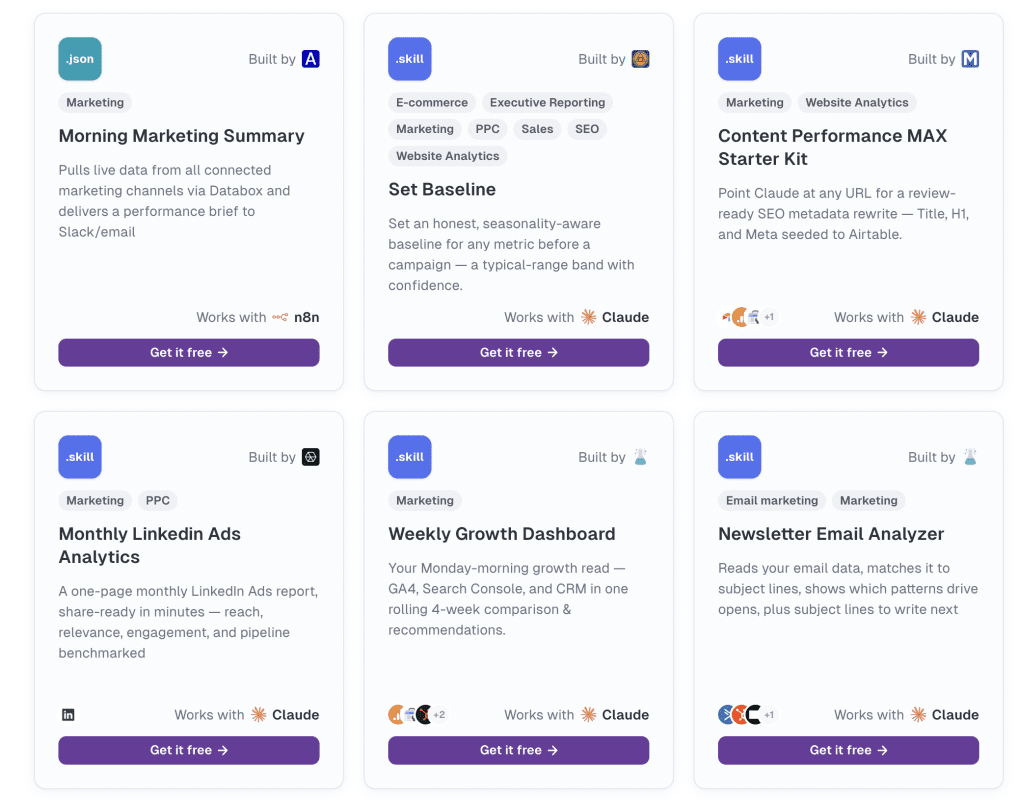
While website analytics and cross-channel paid advertising are the immediate pain points for agencies and marketing teams, the Databox AI Skills Marketplace extends across every vital organ of modern business operations. The library is segmented into deep vertical categories, ensuring that no matter what your specific growth focus is, there is a pre-built skill ready to deploy:
- SEO & Modern Search Visibility: Beyond standard SEO Performance & Visibility Reports that track keywords and organic impressions, the marketplace features forward-looking assets like the AEO (Answer Engine Optimization) Report. This cutting-edge skill tracks your brand’s footprint and conversational visibility inside modern AI engines like ChatGPT, Gemini, Perplexity, and Microsoft Copilot, ensuring your organic strategy is future-proofed for the generative search era.
- Organic Social Media: Consolidate your brand footprint using cross-platform skills that aggregate performance metrics from Instagram, LinkedIn Company Profiles, and YouTube into a unified Organic Social Cross-Platform performance brief.
- E-commerce Operations: The Ecommerce Sales & Conversion Report builds a seamless bridge between Shopify and GA4, allowing brand managers to track inventory velocity, average order value (AOV), and cart abandonment loops in real-time.
- Finance & Revenue Intelligence: Connect directly to your financial source-of-truth with the Stripe Revenue & Payments Report to monitor recurring revenue metrics, monthly growth percentages, and churn behaviors without needing to open financial ledgers.
- Automated n8n Workflows: The backend automation library includes essential operational monitors such as the Weekly SEO Monitor, Traffic Spike Reporter, and Daily Paid Acquisition Intelligence, keeping your operational loops completely hands-free.
How Claude Skills For Analytics and Reporting Changes Agency Margins and Client Retention
For digital marketing agencies, transitioning from manual reporting to an automated AI skills infrastructure fundamentally alters business economics in two ways: Margin Expansion and Client Retention.
1. Reclaiming Profitable Hours
If an agency account manager spends 4 hours per client each month pulling data and writing summaries, an agency with 25 clients wastes 100 hours of high-value labor every single month on data entry.
By automating this loop via the Databox Marketplace, those 100 hours are instantly reclaimed. Your team can spend that time doing what clients actually pay for: auditing creative hooks, optimizing campaign structures, and hopping on strategic consulting calls.
2. Shifting from Proactive to Reactive Client Communication
Most clients cancel agency retainers because they feel out of the loop or can't clearly see the value being generated between monthly review calls.
Delivering automated AI Insights from Databox in Slack or clean, weekly email digests keeps documentation proactive. Clients receive continuous, clearly interpreted proof of execution and performance without your account managers needing to spend their evenings typing out manual update notes.
Zero Risk, Immediate Deployment: How to Get Started with Claude Skills For Analytics and Reporting
The most remarkable aspect of the Databox AI Skills Marketplace is the complete removal of traditional technical and financial barriers to entry.
Historically, setting up advanced serverless data automation required hiring an external data engineer, configuring API endpoints, and paying steep platform subscription fees. Databox has made this entire ecosystem accessible to every level of marketer.
- 100% Free to Download: Every single AI Skill and automated workflow in the library is completely free to access and download.
- Universal Compatibility: These skills run seamlessly across all paid Databox plans—and that includes free trial plans!
- No Credit Card Required: You can spin up a fresh account, map your GA4 or Meta Ads credentials, and deploy your very first automated reporting pipeline in minutes without risking a single dollar.
Stop spending your Mondays acting as a data delivery pipeline for spreadsheets. Shift your agency or marketing team into a high-leverage growth model.
Browse the library, download your core GA4 and Cross-Channel Paid Ads workflows, and let AI handle the reporting infrastructure while you handle the growth.
👉 Browse the Databox AI Skills Marketplace Library Now