If you’re spending money on Facebook ads, to Build Landing Pages For Best ROAS is your first step. You don't point ads to your website. You don't point ads to any specific page on your site.
You point ads to specific, purpose-built landing pages.
Unless you work with a self-created landing page system (possible with Webflow and WordPress with Fast hosting), you'd normally need a landing page software or landing page builder.
your landing page builder is not just a design tool — it’s a profit lever.
The best ROAS usually comes from the builder that helps you create the fastest, most relevant, lowest-friction page for the specific ad you’re sending traffic from.
Just so I say it again, The right builder is the one that lets you match the ad message, keep the page mobile-first, load quickly, and measure everything cleanly. Those factors matter more to ROAS than fancy animations or a huge template library.
What actually drives ROAS on Facebook ads
ROAS rises when the landing page continues the promise made in the ad, removes friction, and makes the next step obvious. The strongest pages do four things well:
- Message match: The headline and offer mirror the ad creative so visitors instantly know they’re in the right place.
- Fast load speed: Pages that load slowly lose mobile traffic quickly, and several guides recommend keeping load time under 3 seconds.
- Clear conversion path: One primary CTA, visible above the fold, reduces confusion and improves action rates.
- Trust and proof: Testimonials, guarantees, and credibility cues reduce hesitation at the decision moment.
That means the “best” builder for ROAS is usually not the one with the most features, but the one that helps you execute those fundamentals consistently.

The builders most likely to win on ROAS
Here’s the practical way to think about the main options.
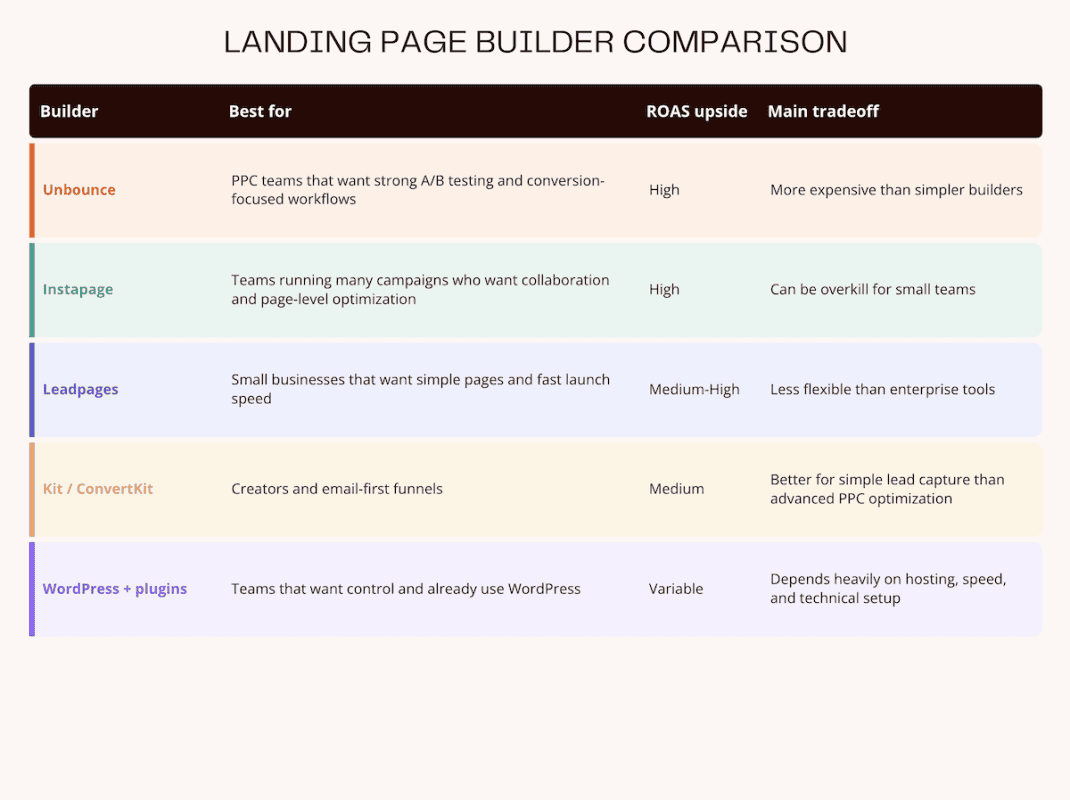
Based on the landing-page best practices surfaced in the sources, the highest-ROAS setups are the ones that support message match, mobile optimization, fast load times, and ongoing testing.
That is why dedicated conversion tools typically outperform generic website pages for Facebook traffic. I've also seen terrific conversion rates when it comes to conversions for lead generation, calls, leads, and more
Why dedicated landing page builders usually beat your homepage
Sending Facebook traffic to a homepage usually hurts ROAS because the visitor has too many choices and not enough context. Facebook ad traffic works better when the visitor lands on a page built for one goal, one offer, and one audience segment.
That is especially important because Facebook ad guidance repeatedly emphasizes:
- a single CTA,
- mobile-responsive design,
- minimal form fields,
- and no distractions like extra navigation links.
A homepage is built for browsing. A landing page builder is built for conversion. Those are different jobs.
What matters more than the platform name
If you want the best ROAS, judge a builder on whether it makes these five things easy:
- Fast mobile performance: Facebook traffic is heavily mobile, so the builder needs lightweight templates and image optimization support.
- Simple testing: You need A/B testing on headlines, CTA copy, layouts, and trust elements so you can improve conversion rate over time.
- Pixel and analytics support: You need reliable tracking so you know which ad set, creative, and page combination actually makes money.
- Form flexibility: Some campaigns need a one-field lead capture page; others need a short qualification form or two-step flow.
- Design control without friction: The builder should help you create a clean page without fighting the editor every time you want to change one element.
That last point matters more than most founders realize. If a builder slows down experimentation, you lose money even if its templates look great.
The best ROAS stack for different business types
1) If you run aggressive paid acquisition and test a lot
Choose a builder that makes it easy to run structured experiments. The sources consistently point to A/B testing, CTA testing, and page-level optimization as key conversion levers. In practice, that means a tool like Unbounce, Leadpages or Instapage is often the strongest fit.
Why this helps ROAS:
- You can test headline variants quickly.
- You can isolate which CTA improves conversion.
- You can tailor pages to audience segments or ad angles.
2) If you need speed and simplicity
If you’re a smaller business or local service brand, a simpler builder may actually produce better ROAS because it gets pages live faster and avoids technical overhead. Leadpages-style tools are often enough when the goal is lead generation, bookings, or a single offer.
Why this helps ROAS:
- You launch faster.
- You spend less time managing tech.
- You can focus on message match and offer clarity instead of platform complexity.
3) If your funnel is email-first
If your Facebook ads mainly drive newsletter signups, lead magnets, or downloads, a creator-focused tool like Kit , Mailerlite or Sequenzy can be enough. The page still needs a strong promise, a single CTA, and fast load performance, but it does not need heavy customization.
Why this helps ROAS:
- Lower friction.
- Faster page creation.
- Easier handoff from ad click to opt-in.
The hidden ROAS killer: slow hosting and unstable infrastructure
A landing page builder can be excellent on paper but still hurt performance if the site is slow or unstable under traffic spikes. Since Facebook ads often create bursts of demand, the infrastructure behind your page matters as much as the builder itself.
I highly recommend the following landing page builders if you don't want to be bothered by the technicalities of VPS, dedicated servers, WordPress Managed Hosting and so on.
You can also go through the comparo of Unbounce Vs LeadPages Vs Instapage, if you want to.
OR
Kinsta's Managed Platform becomes relevant for business owners running paid traffic, because a fast and stable foundation protects the conversion rate your ad budget is buying. If your page lags when a campaign starts working, ROAS drops even if the creative is strong.
For brands pushing paid traffic at scale, infrastructure also affects testing velocity. A builder is only as useful as the environment it runs in, especially when you want to preserve page speed, keep tracking stable, and reduce the chance of downtime during a campaign spike. Kinsta's Isolated Cloud Infrastructure matters here because isolation and performance consistency can protect the user experience when traffic surges.
Read:
Landing Page Mistakes That Are Killing Your Conversions
What the highest-ROAS landing pages have in common
No matter which builder you use, the winning pages usually look similar in structure:
- Headline that repeats the ad promise: Visitors should recognize the offer immediately.
- Short subheadline with benefit framing: Focus on what the visitor gets, not just what the product is.
- One strong CTA: The button should be obvious and action-oriented, not vague.
- Minimal form fields: Ask only for what you truly need.
- Trust signals: Testimonials, results, guarantees, or credibility markers help reduce hesitation.
- Mobile-first layout: Large buttons, easy scrolling, and thumb-friendly design improve completion rates.
This is why many campaigns underperform: the ad is good, but the page creates doubt, delay, or distraction.
Tools to Build Landing Pages For Best ROAS: A practical ranking by potential
If your only goal is which builder is most likely to maximize ROAS, here is the simplest honest answer:
- Unbounce if you care most about testing and optimization.
- Instapage if you run a large campaign portfolio and need page collaboration plus conversion workflows.
- Leadpages if you want solid results with less complexity.
- Kit / simpler creator tools if your funnel is mostly lead capture and email growth.
- WordPress page builders only if your team is strong technically and you can guarantee speed, tracking, and upkeep.
That ranking is based on how well each type of builder supports the conversion practices repeatedly emphasized in the sources: message match, mobile responsiveness, fast load speed, clear CTAs, trust elements, and testing.
The real answer: ROAS comes from fit, not hype
The builder that gives you the best ROAS is the one that matches your traffic volume, testing maturity, and technical capacity. If you are running serious Facebook spend, choose a builder that helps you build fast, test often, and keep the page lightweight enough for mobile traffic.
If you want the most reliable outcome, optimize the entire chain:
- ad promise,
- landing page message match,
- page speed,
- form friction,
- trust signals,
- and tracking accuracy.
That combination almost always beats choosing a “pretty” builder that makes experimentation harder.