Between Leadpages Vs Unbounce Vs Instapage -- best landing page builders I know of, which should the best choice for you? Read on & find out
Note: Most of the features between these three landing page builders are interchangeable. Pick whatever you think is right for your business. Start with free trials, evaluate, and purchase.
Non-hyped TL;DR: If you want the shortest real answer: Leadpages is the easiest and most affordable, Unbounce is the strongest for conversion optimization, and Instapage is the most enterprise-ready for teams running serious paid traffic. The right choice in 2026 depends less on “which builder is best” and more on whether your bottleneck is budget, optimization, or scale.
Here’s the non-hype version: landing page tools are not interchangeable. They solve different business problems. If you’re a founder trying to launch fast, a marketer trying to squeeze more leads from paid traffic, or a team trying to coordinate campaigns across channels, the best platform changes completely.
The real positioning of each tool: My take (after using all three)
Leadpages is built for speed, simplicity, and affordability. It is consistently described as the easiest option for small businesses, solopreneurs, coaches, and creators who need pages that work without a steep learning curve. It also comes with the most number of templates (if that's what moves the needle for you).
Unbounce is the conversion-nerd’s platform. Its core strengths are free-form design control, A/B testing, AI-assisted optimization, and Smart Traffic, which is repeatedly highlighted as a major reason to choose it for paid campaigns.
Instapage is the premium team platform. It stands out for enterprise-style collaboration, AdMap-style ad-to-page alignment, personalization, heatmaps, and a stronger fit for organizations with larger ad budgets and multiple stakeholders.
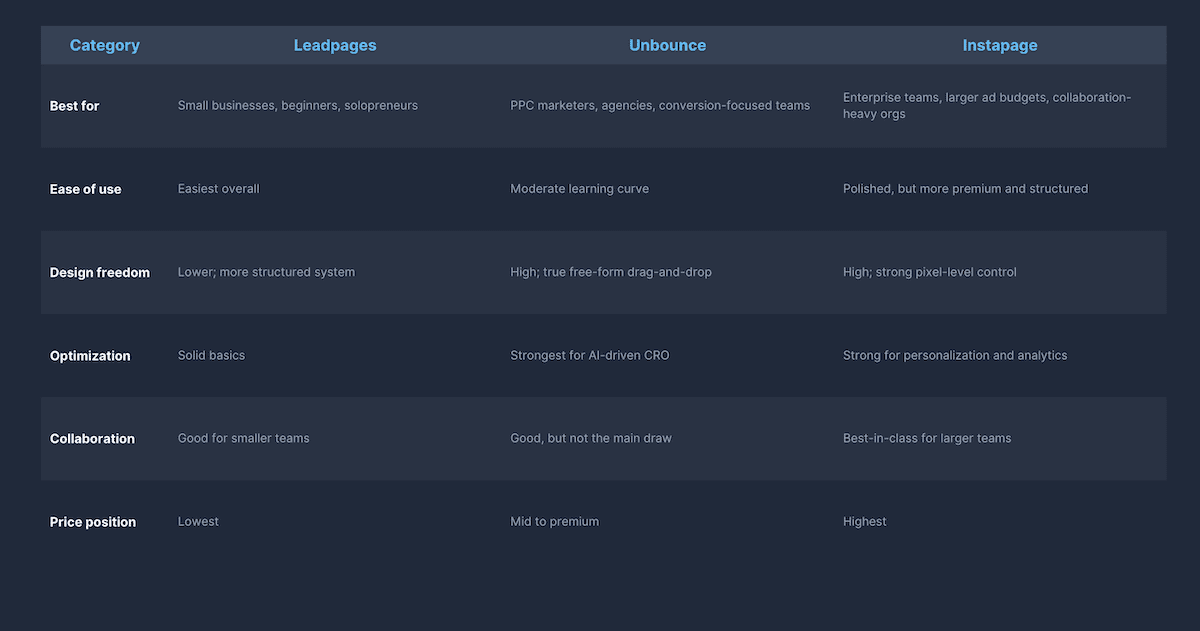
Leadpages Vs Unbounce Vs Instapage: The honest comparison table
Not all landing page builders are built for "everyone". Take a look at this comparison table for Leadpages Vs Unbounce Vs Instapage to quickly pick on insights so that you know might be the best fit for you.
Where Leadpages actually wins
Leadpages wins when your real problem is not “maximize every tenth of a percent of conversion” but “get the damn page out the door today.”
I believe it's the most affordable and simplest option, with a broad template library and a workflow that small businesses can learn quickly.
That matters more than people admit.
Many founders do not lose money because their landing page tool lacks advanced AI. They lose money because their team cannot ship pages consistently. In that scenario, a simpler platform often produces better business outcomes than a more sophisticated one.
Leadpages is also attractive if your team wants a lower-friction setup for lead capture, pop-ups, and straightforward marketing pages.
If you need a practical launchpad rather than a conversion laboratory, it is the least painful option.
Read more:
Where Unbounce is the smartest choice
Unbounce is the best fit when paid traffic is serious enough that optimization directly affects revenue. Multiple sources point to its value for marketers running Google, Meta, or LinkedIn campaigns who need more than templates—they need testing, flexibility, and automated optimization.
Its biggest differentiator is Smart Traffic, which is an AI-driven feature that can improve conversions by routing visitors toward the page variant most likely to convert. If you are interested and want to read more, I wrote about Smart Traffic earlier. While you are at it, also read up on Conversion Intelligence
That is not a cosmetic feature. It creates revenue. Period,
If you spend enough on ads, even a modest lift can justify the platform cost very quickly.
Unbounce also offers the kind of design freedom that performance teams like: a true free-form drag-and-drop editor and strong experimentation workflows. That makes it better than Leadpages for marketers who need to build campaign-specific pages without design constraints.
Read more:
Where Instapage earns its premium
Instapage is the best choice when coordination, personalization, and campaign scale matter more than entry price. The sources consistently frame it as the enterprise-oriented option, with stronger collaboration, personalization features, and tools like AdMap and heatmaps that help larger teams connect ads to landing pages more precisely.
This matters because enterprise landing page pain is rarely about “can we make a page?” It is usually about “can we make dozens of pages, keep them aligned with ad groups, collaborate across stakeholders, and measure what is working?”
Instapage is built around that workflow.
It is also positioned as the most expensive of the three, with pricing and feature packaging that reflect its enterprise posture. That means it is usually the wrong answer for a solo founder or small business unless there is a very clear revenue case.
Where Instapage often outperforms the others is not raw simplicity, but operational maturity. If you run a marketing team with ad-heavy campaigns, review cycles, and a need for consistent page-to-ad relevance, it can save real time and reduce campaign drift.
The biggest mistake buyers make
The biggest mistake is choosing based on “best overall” instead of “best for my bottleneck.” That is how teams overbuy Instapage when they really need Leadpages, or underbuy Leadpages when their ad spend justifies Unbounce.
Here is the clean way to think about it:
- Choose Leadpages if you need the fastest path to launch and your budget is tight.
- Choose Unbounce if you run paid traffic and care about conversion rate optimization.
- Choose Instapage if you manage campaigns at scale and need collaboration plus personalization.
This is the part most comparison posts blur together. They talk about features, but not economics. The right tool is the one that removes the bottleneck that is currently costing you money.
Pricing reality in 2026
Pricing changes, but the shape of the market is clear. Depending on which plan you look at, the pricing level of both Leadpages and Unbounce starts almost the same at the starting point. Then, for higher priced plans, things diverge.
Overall, Leadpages is positioned as the most affordable option, with widely cited tiers starting lower than the competition.
Unbounce either overlaps with Leadpages (depending on plans) or sits in the middle-to-premium range and is justified by optimization features like Smart Traffic and AI copy tools. Instapage is the premium choice and is priced accordingly for team and enterprise use.
From the time I knew these tools to today, pricing has gone up (expected that). But these tools, when you use them right, make up for the spend each month, quarter, and year.
A useful rule: if your monthly ad spend is low, price sensitivity matters a lot. If your monthly ad spend is high, the tool price is usually not the real issue—conversion performance is.
My practical recommendation by business type
If you are a solo founder, consultant, coach, or small business owner, start with Leadpages. You want pages launched quickly, not a six-week tool evaluation.
If you are a performance marketer, agency, or growth team running consistent paid ads, choose Unbounce. You are buying optimization leverage.
If you are a larger team with multiple stakeholders, ad groups, and a need for page-at-scale workflows, choose Instapage. You are buying operational control.
The honest bottom line
Leadpages is the best “get moving now” option. Unbounce is the best “make more money from paid traffic” option. Instapage is the best “coordinate serious campaigns across a team” option.
If you want the most honest 2026 answer possible: don’t buy the platform with the most features. Choose one that matches your current revenue bottleneck, your team’s skill level, and the speed at which your marketing operation actually runs.
Yeah, you got some thinking to do before you commit. Between leadpages Vs Unbounce Vs Instapage, what's your choice going to be?